
 by Bohol Property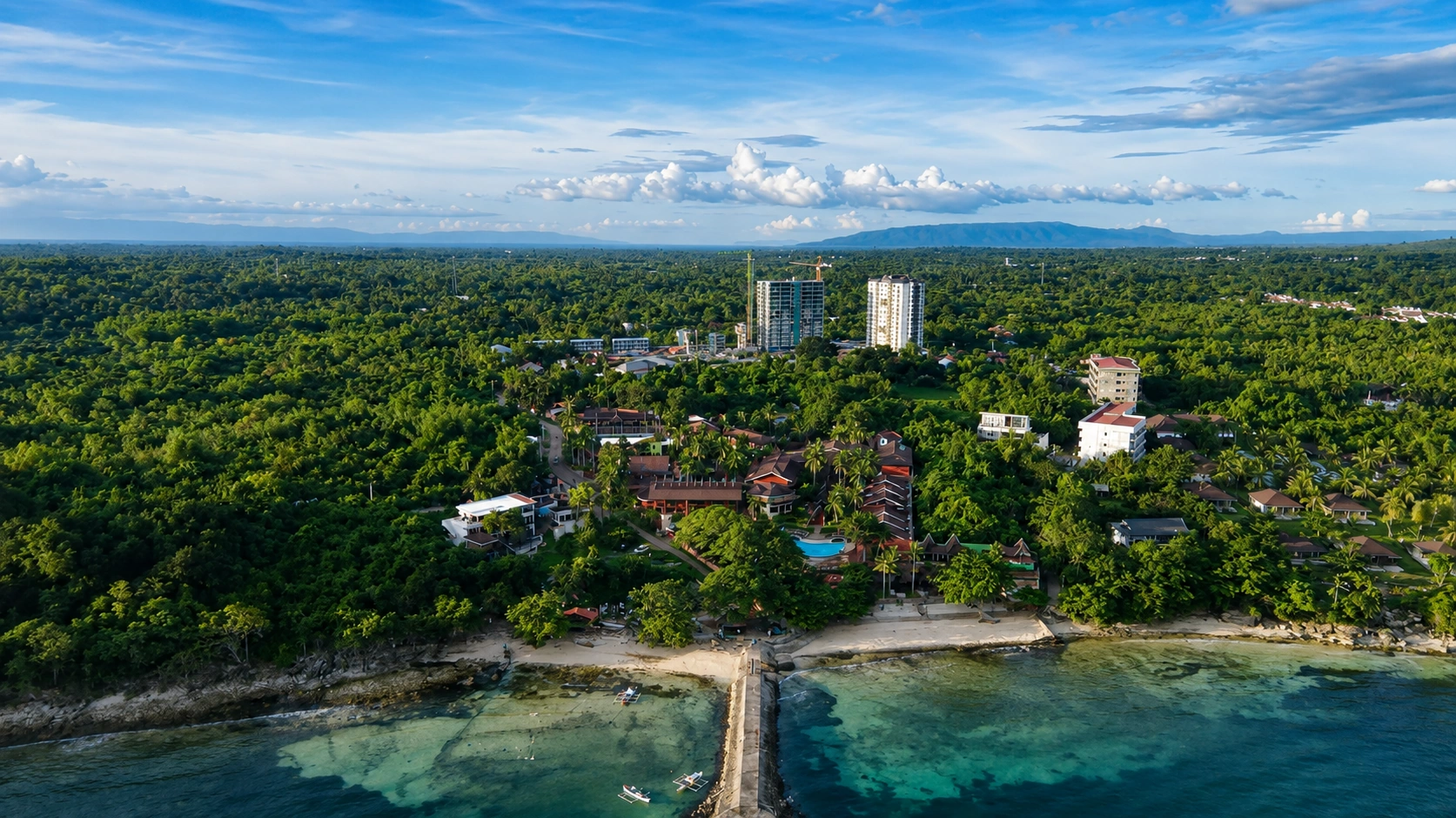
Ask anyone shopping for property in Bohol today where the smart money is going, and the answer keeps circling back to the same stretch of coastline: Panglao town and its neighboring municipality, Dauis. What used to be known mainly for white-sand beaches and dive resorts has quietly become the province’s most active investment corridor — and the numbers, the infrastructure, and the pipeline of new developments all point in the same direction.
The Gateway Effect
Every investment story in Bohol now starts at the airport. Bohol-Panglao International Airport served 2.22 million passengers in 2025, cementing its role as the province’s main entry point for both local and foreign visitors. The airport was handed to a new private operator, Aboitiz InfraCapital, in mid-2025, and the group also runs Mactan-Cebu and Laguindingan — a sign that Panglao’s gateway is now managed as part of a serious regional aviation network rather than a standalone provincial strip.
That connectivity keeps expanding. Bohol welcomed its first direct charter flight from Japan in May 2026, adding to an already strong base of Korean travel demand that has anchored the island’s international arrivals since 2023. New routes translate directly into rental demand for the condos, villas, and short-term-rental units concentrated in Panglao and Dauis — which is exactly why developers keep breaking ground within a few kilometers of the runway.
The Numbers Behind the Boom
Bohol as a whole logged more than 1.4 million visitor arrivals in 2025, up about 4.2 percent from 2024, with roughly 59 percent domestic and 41 percent foreign travelers. Growth has cooled from the explosive 36-percent jump the province saw in 2024, but that’s arguably healthier for long-term investors: a maturing market with steadier, more sustainable demand rather than a short-lived spike.
Foreign visitor patterns are shifting too. South Korea has long been Bohol’s dominant international source market, at times making up more than 40 percent of foreign arrivals, though 2025 saw a pullback in Korean numbers. In their place, resort operators report a rising share of Australian and American guests, who tend to book higher room categories and show strong interest in sustainability-focused, community-based experiences — a trend that is nudging developers in Panglao and Dauis toward higher-spec, more premium product.
Where the Development Is Actually Happening
Dauis, once treated as Panglao’s quieter back door, is now home to some of the most visible projects in the province. Royal Oceancrest Panglao 2, developed by PrimaryHomes in Barangay Dao, is a resort-style condominium project with over a thousand units, prized for its short drive to the airport and its position within Panglao’s established resort belt. Nearby, Palm Oasis Residences is bringing a seven-story, multi-hundred-unit condo-villa community to the same barangay, aimed squarely at buyers who want both a home and a rentable investment asset.
Beyond the condo towers, the broader Dauis market is dense with smaller opportunities: titled residential and commercial lots along the Dauis–Panglao Road, beachfront-adjacent villa compounds available for sale or long-term lease, and operating boutique resorts changing hands as owner-investors cash out or scale up. This mix matters for investors — Panglao and Dauis aren’t a single product type but an ecosystem spanning raw land, pre-selling condos, turnkey villas, and income-generating hospitality assets.
Infrastructure Catching Up With Demand
The province isn’t leaving growth to the airport alone. A proposed Third Tagbilaran–Panglao Bridge is aimed at easing the connection between the island and the mainland capital, which today carries the bulk of passenger and goods traffic between the two. Provincial officials have also been pursuing tourism circuits that spread visitor traffic — and future investment interest — into towns beyond Panglao, such as Loboc, Anda, and Carmen. For Panglao and Dauis specifically, that spillover works in their favor rather than against it: as the established gateway, they remain the logical base from which visitors branch out, reinforcing demand for accommodation and rental stock right at the source.
Accommodation supply is already responding. Bohol’s registered accommodation inventory grew to over a thousand establishments in 2025, up from under a thousand the year before, with a rising share now formally accredited — a signal that the market is professionalizing, not just expanding.
What This Means for Investors
Put together, the picture is straightforward: an airport handling more passengers than ever, under new management with a regional network behind it; a tourism base that’s still growing, even if more slowly than the 2024 surge; a widening mix of source markets pushing developers toward higher-quality product; and a real, visible pipeline of condominium, villa, and resort projects concentrated almost entirely in Panglao and Dauis rather than spread thin across the province.
That combination — reliable access, sustained (if moderating) demand, and active new supply — is precisely what makes a location attractive to property investors, whether the goal is a vacation home, a short-term rental unit, or a longer-term land play. Panglao and Dauis aren’t just Bohol’s tourism face anymore; they’re becoming its investment address of record.

